Five years ago, creatine lived in one place: the gym bag. It was the powder for people chasing an extra rep or a bigger bench. Now it shows up in longevity podcasts, healthy-aging newsletters, and your physician's small talk. If you have searched creatine for longevity and wondered whether the hype changed or the science did, the short answer is both, and it helps to know which is which.
This article is the practical version of that conversation. Not an academic review, not an influencer pitch. We will walk through why researchers who study aging keep bringing up creatine, what the evidence actually supports at each decade of life, where the claims outrun the data, and how to use it sensibly if you decide it belongs in your routine. If creatine for longevity turns out to be a real category and not just a rebrand, it will be for the unglamorous reason at the center of aging research: keeping muscle on your frame for as long as possible.
One thing to state plainly up front: creatine is not a longevity drug. No supplement has been shown to extend human lifespan. What creatine has is an unusually deep research base for a supplement, a strong safety record in healthy adults, and a plausible role in the things that make later decades livable: strength, mobility, and possibly cognition.
5g creatine monohydrate · 20g whey isolate · 10g collagen matrix · 30g protein
Why longevity researchers talk about creatine
Creatine is a compound your body already makes and stores, mostly in muscle, where it helps regenerate ATP, the quick-turnaround energy currency your cells burn during hard efforts. You also get some from meat and fish. Supplementing tops off those stores beyond what diet and natural production provide.
That energy-buffering role is why it became a performance supplement. The longevity interest comes from a different direction: what happens to the human body after about age 30.
- Adults lose muscle mass gradually from roughly their 30s onward, and the rate accelerates later in life. Researchers call the advanced version sarcopenia.
- Muscle loss is not cosmetic. It tracks with falls, fractures, frailty, loss of independence, and worse outcomes after illness or surgery.
- Strength training is the proven countermeasure, and creatine is one of the few supplements with consistent evidence that it amplifies the results of that training.
- Tissues with high energy demand, including the brain, also use creatine, which opened a second research front around cognition and aging.
Put those together and you get the pitch that longevity researchers actually make. It is not "creatine makes you live longer." It is "creatine helps you keep the muscle and function that make aging go better." Health systems have picked up the same thread; UCLA Health has covered why the supplement's audience widened from bodybuilders to older adults and women in midlife (UCLA Health: Why everyone's talking about creatine).
There is also a hype cycle running alongside the science, and it is worth naming. Creatine is having a moment on social media, where reasonable findings about muscle preservation get stretched into claims about reversing aging, transforming skin, or fixing everything from mood to metabolism. The research is genuinely promising in some areas. It is early or thin in others. A supplement can be worth taking and still be overhyped at the same time, and creatine in 2026 is a clean example of that.
What creatine research means at every age
Here is the framing you will not find on most pages ranking for this topic: the case for creatine is not one argument, it is a different argument depending on the decade you are in, because the underlying muscle biology changes. The muscle-loss research gives each decade its own logic.
| Decade |
What is happening to your body |
What the creatine research suggests |
| 30s |
Muscle mass and strength quietly peak, then begin a slow decline if you do not train. |
The classic performance case. Creatine plus resistance training builds a bigger reserve of muscle and strength, which is the buffer you draw down for the rest of your life. |
| 40s |
Decline becomes measurable. Recovery slows. For many women, perimenopause accelerates muscle and bone changes. |
Creatine helps you train harder and recover between sessions, protecting training consistency. Research interest in creatine for women in midlife has grown sharply, on both muscle and mood-adjacent outcomes, though the female-specific evidence base is still smaller. |
| 50s |
Muscle loss picks up speed. Bone density becomes a live concern. Strength starts to predict future health outcomes. |
The best-supported window. Multiple reviews of creatine supplementation in older adults find that creatine combined with resistance training produces greater gains in lean mass and strength than training alone. |
| 60s+ |
Sarcopenia risk becomes real. Falls and fractures are the events that end independence. Appetite and protein intake often drop. |
Creatine remains effective, and the functional stakes are highest: leg strength, chair-rise ability, and stair climbing are the outcomes studies measure. The consistent caveat is that creatine works with training. Taken on the couch, it does very little. |
Two honest footnotes to that table. First, the effect sizes are meaningful but modest; creatine is an amplifier of resistance training, not a substitute for it, in any decade. Second, most of the older-adult evidence comes from studies pairing creatine with supervised strength programs, which is exactly the context you should copy.
5g creatine monohydrate · 20g whey isolate · 10g collagen matrix · 30g protein
Muscle preservation as you age
If you take one mechanism away from this article, make it this one: the strongest longevity argument for creatine is that it helps you build and keep skeletal muscle, and skeletal muscle is one of the best predictors of how well people age.
The way it works is straightforward. Higher creatine stores let your muscles regenerate energy faster during short, hard efforts. That means a few more quality reps per session and better maintenance of training intensity over weeks. Compounded across months of resistance training, that extra work shows up as more lean mass and more strength than training alone typically produces. Reviews of creatine supplementation in older adults consistently point in this direction, which is why the geriatric and sports-science communities largely agree on this specific use case.
For a practical athlete, that reframes what "results" means as you get older:
- In your 30s and 40s, results look like performance: heavier lifts, faster recovery, more productive training blocks.
- In your 50s and beyond, results look like function: getting off the floor easily, carrying groceries up stairs, absorbing a stumble without a fracture.
- Across all decades, the deposit is the same. Muscle built earlier is reserve you spend later.
Cleveland Clinic's overview of the supplement lands in the same place: the well-established benefits are muscle and performance related, and they depend on actually training (Cleveland Clinic).

Brain and cognitive support
This is the part of the creatine conversation that generates the most excitement and deserves the most caution.
The theory is reasonable. The brain is an energy-hungry organ that maintains its own creatine stores, and those stores appear to decline with age. Supplementation can raise brain creatine modestly. Small studies have looked at memory and cognitive performance, particularly in older adults and in stressed conditions like sleep deprivation, and some show benefit.
But "some small studies show benefit" is a very different evidence tier than the muscle data. The honest summary:
- The cognitive findings are early, mixed, and based on much smaller trials than the muscle research.
- Effects, where they appear, tend to be modest and are more consistent in older adults and vegetarians, who start with lower stores.
- No trial shows creatine prevents dementia, Alzheimer's disease, or age-related cognitive decline. Anyone claiming that is ahead of the data.
If the brain research pans out, it would meaningfully strengthen the longevity case, since cognition and muscle are the two pillars of independent aging. For now, treat any brain benefit as a possible bonus on top of a muscle rationale that stands on its own.
Bone and metabolic angles
Two quieter research threads round out the longevity picture.
Bone. Creatine does not act on bone directly the way calcium or vitamin D do. The hypothesis is indirect: stronger muscles pull harder on bone during training, and that mechanical loading stimulates bone maintenance. Some longer trials in postmenopausal women pairing creatine with resistance training suggest slower bone density loss at some sites, while others show no difference. Interesting, unsettled, and again dependent on training. The bone question is most pressing for women through menopause; we cover that research in our guide to creatine for women.
Metabolism and daily energy. Creatine may support glucose handling in muscle and is being studied alongside exercise in this context, but it is not a treatment for any metabolic condition. The more grounded version is simply that people who can train harder and recover better tend to move more, and movement drives most of the metabolic benefit.
Neither of these angles would justify creatine on its own. They are supporting characters in a story where muscle is the lead.
5g creatine monohydrate · 20g whey isolate · 10g collagen matrix · 30g protein
What the evidence does not show yet
A longevity article earns trust by being clear about the ceiling, so here is the list, stated plainly.
- No lifespan effect. There is no human evidence that creatine extends how long you live. The research is about healthspan markers: strength, lean mass, function, and possibly cognition.
- No standalone effect worth chasing. Without resistance training, creatine's measurable benefits shrink toward the trivial. The supplement amplifies stimulus; it does not replace it.
- Skin and appearance claims are thin. Small industry-connected studies on topical creatine and skin exist, but "creatine makes your face younger" is marketing, not established science. Any facial fullness from oral creatine is mostly water-related and subtle.
- Brain claims are ahead of the trials. Covered above, and worth repeating, because it is the most over-sold angle in the current hype cycle.
- It is not for everyone by default. A supplement with a good safety record is still a supplement. People with kidney disease or other medical conditions belong in a conversation with their clinician first, not in a checkout flow.
None of this weakens the real case. It defines it. The reason to consider creatine after 40 is boring and strong: it reliably helps training build and keep muscle, and muscle is longevity infrastructure.
Dosing for longevity vs performance
The practical good news: the longevity use case does not require anything exotic. The protocol that decades of research validated is the one to copy.
- Form: creatine monohydrate. It is the version used in nearly all of the research, including the older-adult trials, and nothing newer has beaten it. The NIH Office of Dietary Supplements reviews it as one of the few performance ingredients with consistent supporting evidence (NIH Office of Dietary Supplements).
- Dose: 3-5 grams per day. That is the standard studied maintenance dose, and it applies whether you are 35 or 70.
- Loading: optional. A loading phase (higher split doses for about a week) saturates muscle stores faster, but a steady 3-5 g/day reaches the same place in three to four weeks. For a longevity timeline measured in decades, there is no urgency.
- Timing: whenever you will remember it. Consistency matters far more than clock time. Daily intake is the whole game, because benefits come from saturated stores, not from an acute pre-workout effect.
- Hydration: drink normally. Creatine pulls water into muscle cells, so keep up ordinary fluid intake. There is no need for extreme water protocols.
The main difference between a performance protocol and a longevity protocol is not the dose. It is the mindset: performance users cycle and periodize; a longevity user simply takes it daily, indefinitely, alongside two to four strength sessions a week.
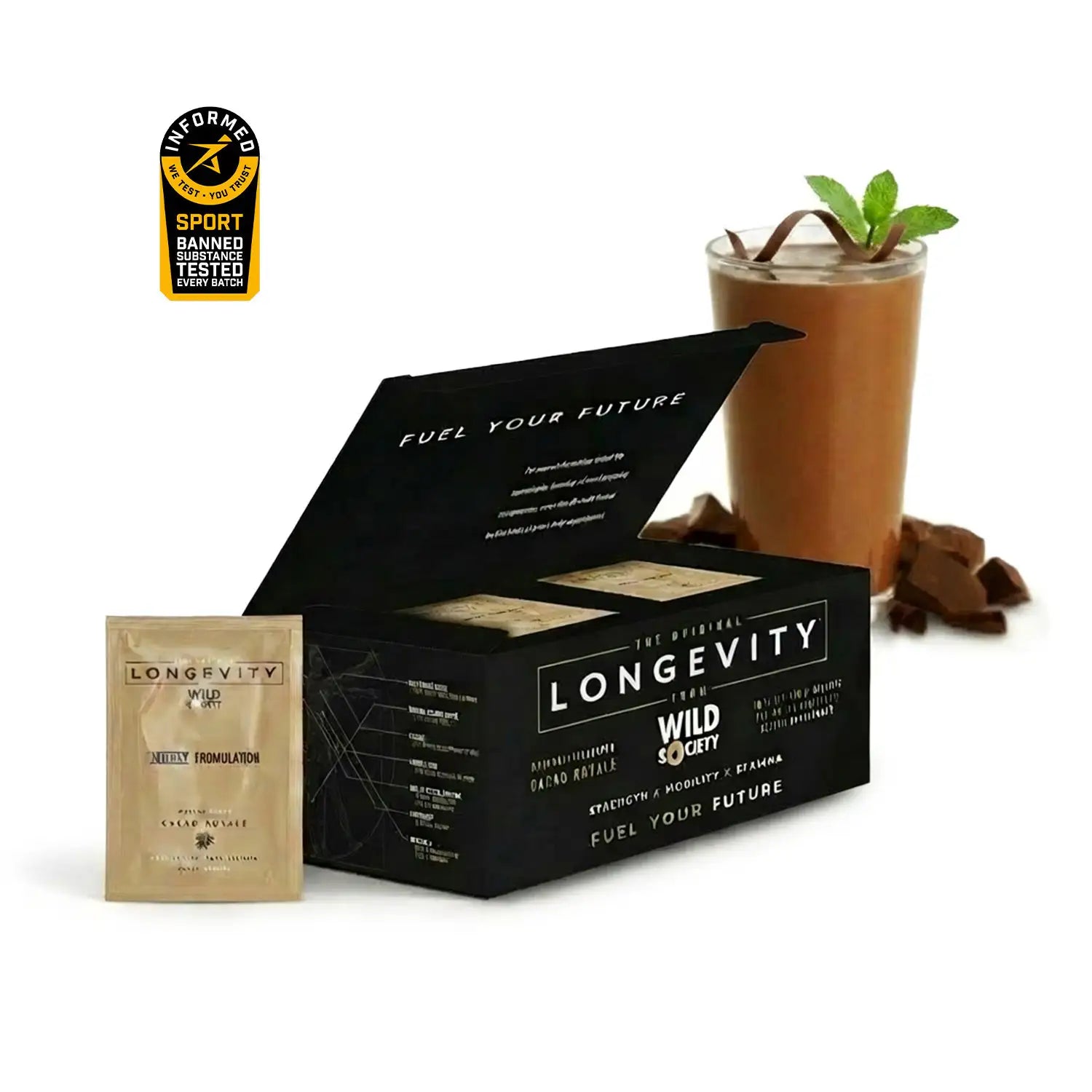
This is also where formulation choice comes in. Some people prefer a standalone monohydrate powder, and if your only goal is isolated creatine dosing, a plain monohydrate does that job. Others would rather fold creatine into a broader healthy-aging stack and keep one daily routine. Wild Society's Longevity takes the second approach: 5g of creatine monohydrate per serving, the top of the studied range and the same form used in the research, alongside 20g of whey isolate and a 10g collagen matrix. One daily habit covers the stack.
5g creatine monohydrate · 20g whey isolate · 10g collagen matrix · 30g protein

Safety and who should check first
Creatine monohydrate is one of the most-studied supplements in existence, and in healthy adults at standard doses its safety record is strong. Still, "well-studied and generally safe" is not "safe for everyone, always." Here is the balanced picture.
Common and generally harmless:
- Water weight. Expect a pound or two early on as muscle cells hold more water. This is intracellular water, not fat, and it is part of how creatine works.
- Mild digestive upset in some people, usually solved by taking it with food or splitting the dose.
The kidney question. This is the concern behind most "doctors say no" stories, and it deserves a straight answer. Creatine supplementation raises creatinine, a lab marker clinicians use to estimate kidney function, which can make healthy kidneys look stressed on a standard panel. In people with healthy kidneys, research has not shown creatine at normal doses causes kidney damage. But in people with existing kidney disease or impaired kidney function, the calculus changes, and creatine is not recommended without medical supervision.
Check with a clinician first if any of these apply:
- You have kidney disease, a history of kidney problems, or take medications that affect the kidneys
- You have any significant chronic condition or take prescription medications daily
- You are pregnant or breastfeeding, where data is simply lacking
Two more practical notes. The hair-loss worry traces back to a single small study on a hormone marker, and subsequent research has not confirmed that creatine causes hair loss. And on quality: choose products that use creatine monohydrate and are third-party tested, because supplement quality varies more than supplement marketing does.
FAQ
Why do doctors say no to creatine?
Usually for one of three reasons: the patient has kidney disease or impaired kidney function, where creatine is not recommended without supervision; the doctor wants to avoid muddying creatinine-based kidney lab tests; or the advice is simply dated, from the era when creatine was seen as a bodybuilding-only product. For healthy adults at 3-5 g/day, major health systems now describe creatine as well tolerated. If your doctor says no, ask which of these reasons applies to you.
Should men over 40 take creatine?
If a man over 40 is strength training (and he should be), creatine is one of the few supplements with solid evidence behind it. The 40s are when muscle loss becomes measurable, and creatine plus resistance training helps counter it more effectively than training alone. The standard 3-5 g/day of monohydrate applies. Men over 40 are also more likely to be on daily medications, so the check-with-your-clinician rule matters more, not less.
What is the downside of creatine?
For most healthy adults: a pound or two of water weight, occasional mild stomach upset, the cost, and one more daily habit to maintain. The meaningful downside applies to people with kidney conditions, who should not take it without medical guidance. The other downside is disappointment from inflated expectations; creatine without strength training does very little.
Is creatine good for anti-aging?
It depends on what "anti-aging" means. Creatine does not slow aging itself and does not extend lifespan. What the evidence supports is that creatine, combined with resistance training, helps preserve muscle mass and strength as you age, and muscle is one of the strongest predictors of late-life function and independence. That is a real anti-aging benefit in the practical sense, even though it is not the fountain-of-youth version.
Can creatine make your face look younger?
Probably not in any meaningful way. Oral creatine increases water content in muscle, which can add subtle fullness overall, and a few small studies have looked at topical creatine in skincare, but the evidence that supplementing creatine visibly rejuvenates your face is thin. If you see this claim, you are looking at the hype cycle, not the research.
Should a 70 year old take creatine?
This is actually one of the better-supported use cases, with two conditions. First, the 70-year-old should be doing some form of resistance training, because that pairing is where the older-adult research shows gains in strength, lean mass, and functional measures like chair rises. Second, a clinician should sign off first, since kidney function and daily medications are more common considerations at 70. With both boxes checked, the standard 3-5 g/day of monohydrate is the studied approach, and no loading phase is needed.
The bottom line
Creatine earned its place in the longevity conversation for one defensible reason: it reliably helps resistance training build and preserve muscle, and muscle is the closest thing aging research has to a keep-your-independence asset. The brain, bone, and metabolic angles are worth watching but not worth banking on yet. Take the studied dose, pair it with strength work, hydrate normally, loop in your clinician if you have kidney concerns, and ignore anyone promising a younger face or a longer life from a scoop of powder. The real offer is better than the hype: more strong, capable years, earned a few grams and a few reps at a time.
This article is for general informational purposes and isn't medical advice.