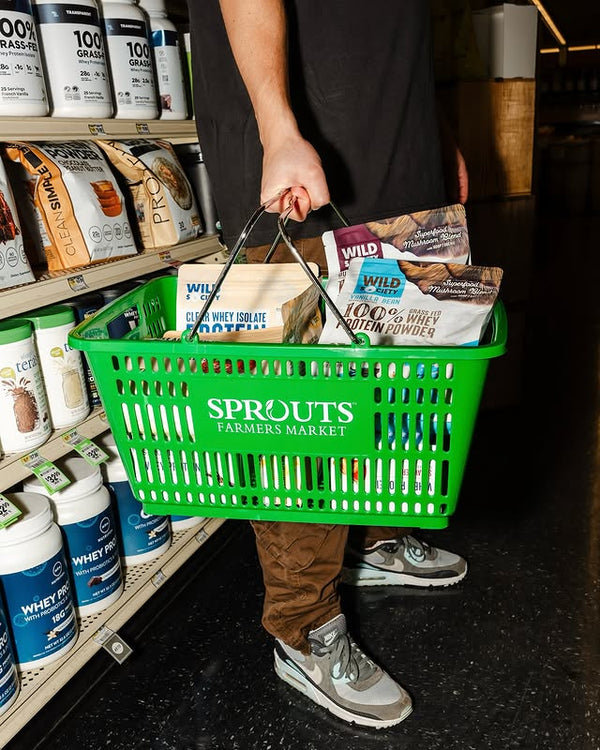

High-Protein Snacks: Easy Options That Actually Keep You Full
Dietitian-grade list of high-protein snacks for on the go, at home, and post-workout, with protein counts and simple ways to hit 20-30 g per snack.

Ethan GettyAsk a nutrition-minded friend "is beef jerky healthy" and you will get two confident, opposite answers. One camp sees a nearly perfect snack: dense protein, almost no sugar, no refrigeration, fits in a jacket pocket. The other camp sees a processed meat soaked in sodium and coated in teriyaki glaze, and points to cancer researchers who put processed meat on their watch list. Both camps are describing something real. They are just describing different bags of jerky.
That is the honest answer to "is beef jerky healthy": it depends on the jerky, and the gap between the best and worst options on the shelf is wider than for almost any other snack category. A simple, single-ingredient-style jerky made from lean beef and salt is one of the strongest protein-per-calorie snacks you can buy. A candied, cure-heavy jerky can carry a third of your daily sodium and a dessert's worth of added sugar in one bag. Same aisle, very different nutrition.
This article walks through what jerky actually is, what the protein numbers look like, the legitimate concerns (sodium, sugar, and the processed meat question, handled straight, not hand-waved), how to read a label like someone who cares, and where jerky fits next to bars, shakes, and cheese. By the end you will be able to look at any bag and know within ten seconds which camp it belongs to.
Jerky is one of the oldest food preservation methods humans have: take meat, remove most of the water, and it keeps. Modern beef jerky starts with cuts of beef that are sliced thin, usually marinated or seasoned, and then dried at low heat (or air-dried) until the moisture content is low enough that bacteria cannot thrive. The leaner the starting cut, the better it dries and keeps, which is why traditional jerky uses lean muscle cuts rather than fatty ones. If you are curious how much the starting cut matters, we broke that down in a full guide to the best cuts of meat for making jerky.
The drying step is what makes jerky nutritionally unusual. Removing water concentrates everything that remains:
That last point is where jerky products diverge. The ingredient list on a bag of jerky can be three items long (beef, salt, maybe vinegar or spices) or it can be fifteen items long, with several forms of sugar, sodium nitrite, MSG, and caramel color. The beef is the same species; the products are not the same food.
So when someone asks whether jerky is healthy, the first counter-question should be: which recipe? A minimalist jerky is essentially concentrated lean beef with salt. A convenience-store teriyaki jerky is closer to meat candy. The rest of this article treats those as the two ends of a spectrum, because nutritionally, they are.
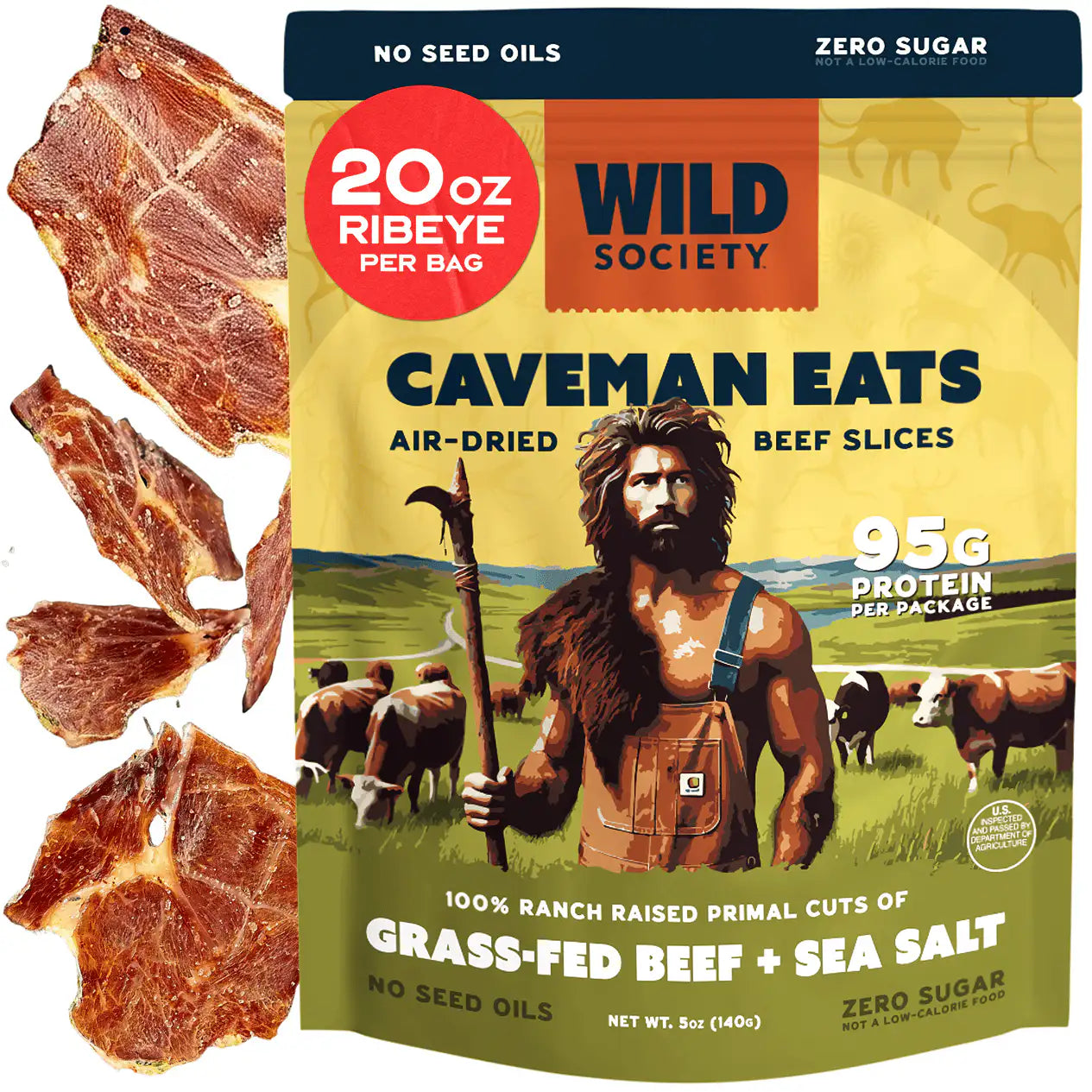
Ribeye steak slices · 95g protein per bag
Protein is the reason jerky earns a place in the conversation at all, so let us put real numbers on it.
According to the composition data in USDA FoodData Central (USDA FoodData Central), typical beef jerky delivers roughly 9 to 11 grams of protein per ounce, at around 70 to 115 calories per ounce depending on how much sugar the recipe adds. That protein density puts jerky in elite company among portable snacks:
Premium simple-recipe jerky pushes the protein numbers higher still, because nothing dilutes the meat. When there is no sugar glaze and the slices are dried harder, more of every ounce is actual beef. Wild Society's Caveman Eats ribeye steak slices are a clean example of the category ceiling: grass-fed ribeye, slow-cooked at low temperatures, coming in at 95g of protein per 5oz bag, roughly double the protein density of mainstream jerky. That is not a marketing rounding trick; it is what happens when the recipe is beef and salt and the water is actually gone.
The quality of the protein matters too. Beef is a complete protein, meaning it carries all nine essential amino acids in useful amounts, including the leucine that drives muscle protein synthesis. That is why jerky shows up in gym bags and not just glove compartments: it is one of the few shelf-stable foods that delivers complete animal protein without refrigeration, cooking, or a shaker bottle.
Two honest notes before we move on. Protein density is only half the label; the other half, sodium and sugar, is where jerky earns its critics, and we go there next. And jerky is not the cheapest protein per gram. What you are paying for is protein that needs no fridge, no prep, and no cleanup, and at the premium end, Caveman Eats packs 95g of protein into a single 5oz bag.
Ribeye steak slices · 95g protein per bag
A fair answer to "is beef jerky healthy" has to spend as much time on this section as on the protein section. There are three legitimate concerns, and they deserve to be sized honestly rather than dismissed or inflated.
Salt is not an accident in jerky; it is part of how jerky is preserved. Typical commercial jerky runs about 400 to 600 milligrams of sodium per ounce, and some cure-heavy products go well beyond that, so compare labels rather than assuming the category is uniform.
What that means practically:
Nobody expects dessert-level sugar in a meat snack, which is exactly why it slips through. Teriyaki, sweet-and-spicy, honey-glazed, and barbecue flavors commonly carry 5 to 9 grams of added sugar per serving, and some exceed that. Eat half a large bag and you have consumed a cookie's worth of sugar alongside your protein. Sugar also inflates the calorie count and dilutes the protein density, which quietly ruins the main reason you bought jerky in the first place. The fix is simple: read the added-sugar line. The best jerky products have a zero or a one there.
Many mainstream jerkys use sodium nitrite as a curing agent, along with flavor enhancers like MSG and various binders. Nitrite is the ingredient most tied to the processed-meat health debate, which gets its own section below because it deserves more than a sentence. The practical point here: jerky can be made without nitrite cures. Air-dried, salt-only jerky demonstrates that drying plus salt does the preservation job the old way, with an ingredient list you can recite from memory.
None of these concerns erases the protein case. They define its boundaries. Jerky is a food where the label decides whether you are getting the good version of the deal.
Yes, and there is no honest way around it. Beef jerky is dried, salted, and often cured meat, which places it in the "processed meat" category as health researchers define it. In 2015, the WHO's cancer research agency classified processed meat as a Group 1 carcinogen, and its own Q&A on the topic (Carcinogenicity of the consumption of red meat and processed meat) is the source worth reading rather than the headlines it generated. Two points from it matter most:
The American Cancer Society's Guideline for Diet and Physical Activity (American Cancer Society Guideline for Diet and Physical Activity) turns that evidence into practical advice: limit red and processed meats within a healthy eating pattern, rather than banning any single food.
What you control is the ingredient list. Nitrite cures are the most-debated variable in that research, and salt-preserved products avoid that additive entirely. The same label check that handles sodium and sugar handles this one too.
Ribeye steak slices · 95g protein per bag
Everything above collapses into a short checklist you can run in the snack aisle. The healthiest beef jerky is the one that maximizes protein and minimizes everything else, and the label tells you exactly which products do that. We keep a deeper walkthrough in our guide to choosing the best high-protein beef jerky, but the core checks are these:
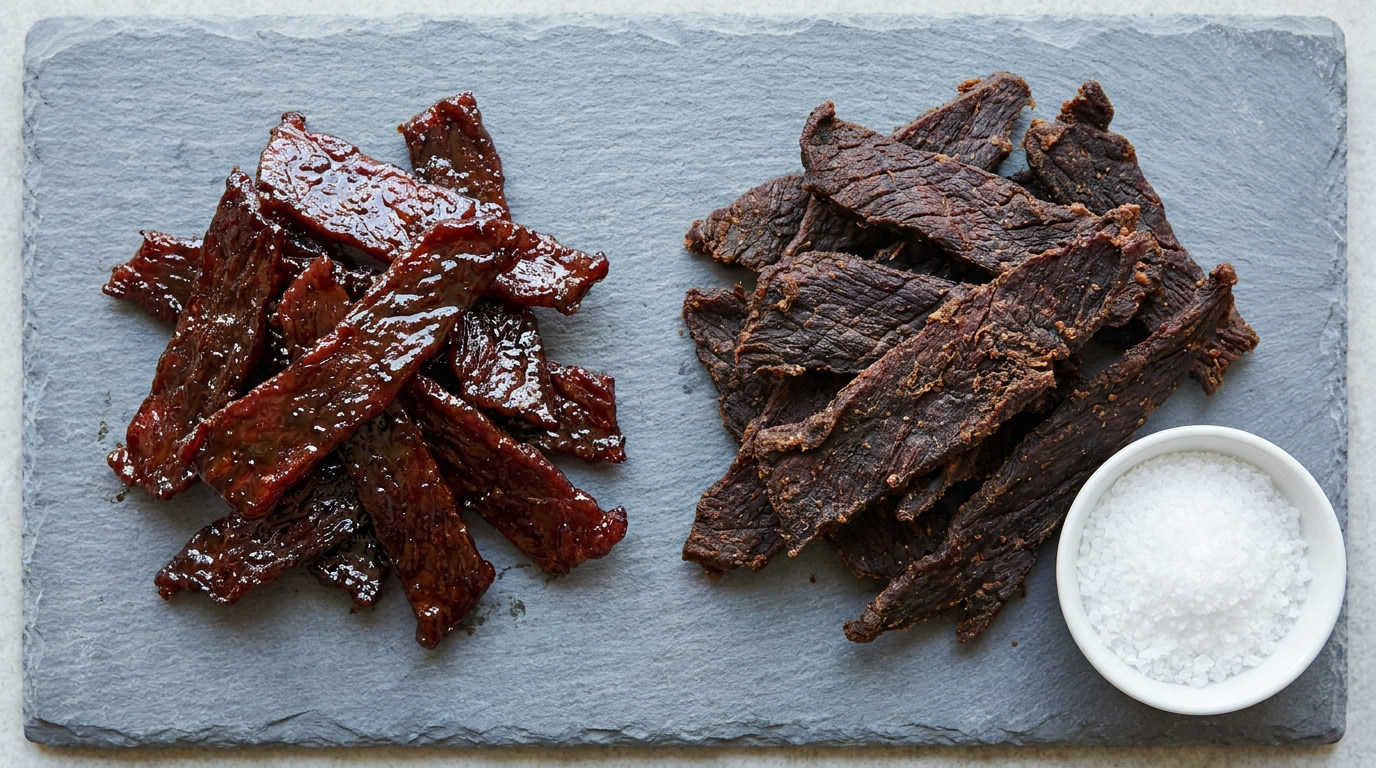
Here is what those checks look like as typical ranges across the two ends of the market. The numbers are honest typical ranges, not any single brand's panel, and individual products vary:
| Label check | Typical mainstream jerky | Premium simple-ingredient jerky |
|---|---|---|
| Protein per ounce | 9-11 g | 14-19 g |
| Added sugar per serving | 3-9 g | 0-1 g |
| Ingredient count | 8-15 (incl. sugars, nitrite, flavorings) | 2-5 (beef, salt, spices) |
The right-hand column is the version of jerky the protein case in this article describes. Caveman Eats sits at the far edge of it: grass-fed ribeye steak slices, slow-cooked at low temperatures, at 95g of protein per 5oz bag, roughly double the protein density of mainstream jerky. The point of the table is not that one brand wins; it is that the spread is real, and the label makes it visible in seconds.
One more honest note on homemade jerky, since people ask: making your own gives you total control of the salt and sugar, which is genuinely healthier on those two lines. The tradeoff is food safety. Home dehydrators need to hit adequate internal temperatures to make lean meat safe, so follow a tested recipe and drying protocol rather than improvising.
Jerky does not exist in a vacuum. The real decision most people face at 3 p.m. is jerky versus a protein bar versus chips versus string cheese versus a shake. Each has a job it does best. We have a broader roundup of high-protein snacks if you want the full field, but here is the head-to-head:
| Snack | Protein (typical serving) | Processing level | Shelf life | Best use |
|---|---|---|---|---|
| Beef jerky (simple recipe) | 9-19 g per oz | Dried, salted; minimal additives at the premium end | Months, no fridge | Travel, hiking, desk drawer, post-workout when a fridge is far away |
| Protein bar | 10-20 g per bar | Highly formulated: syrups, binders, coatings | Months | Meal-gap emergencies, sweet-tooth management |
| Potato chips | 2 g per oz | Fried, salted | Months | Not a protein snack; it is a texture snack |
| Cheese (string/cubes) | 6-8 g per oz | Minimal; it is just cheese | Weeks, refrigerated | Home and office snacking with fridge access |
| Whey protein shake | 20-30 g per scoop | Isolated protein powder | Long (powder) | Post-workout dosing, hitting daily protein targets precisely |
A few takeaways from that table, including the answer to a question people search constantly: what snack is actually highest in protein? Per serving as normally eaten, a whey shake wins outright at 20 to 30 grams. But per ounce among foods you can chew, high-protein jerky is at or near the top of the entire snack world, and it beats every option on the list for portability, since it needs no fridge, no shaker, and no cleanup.
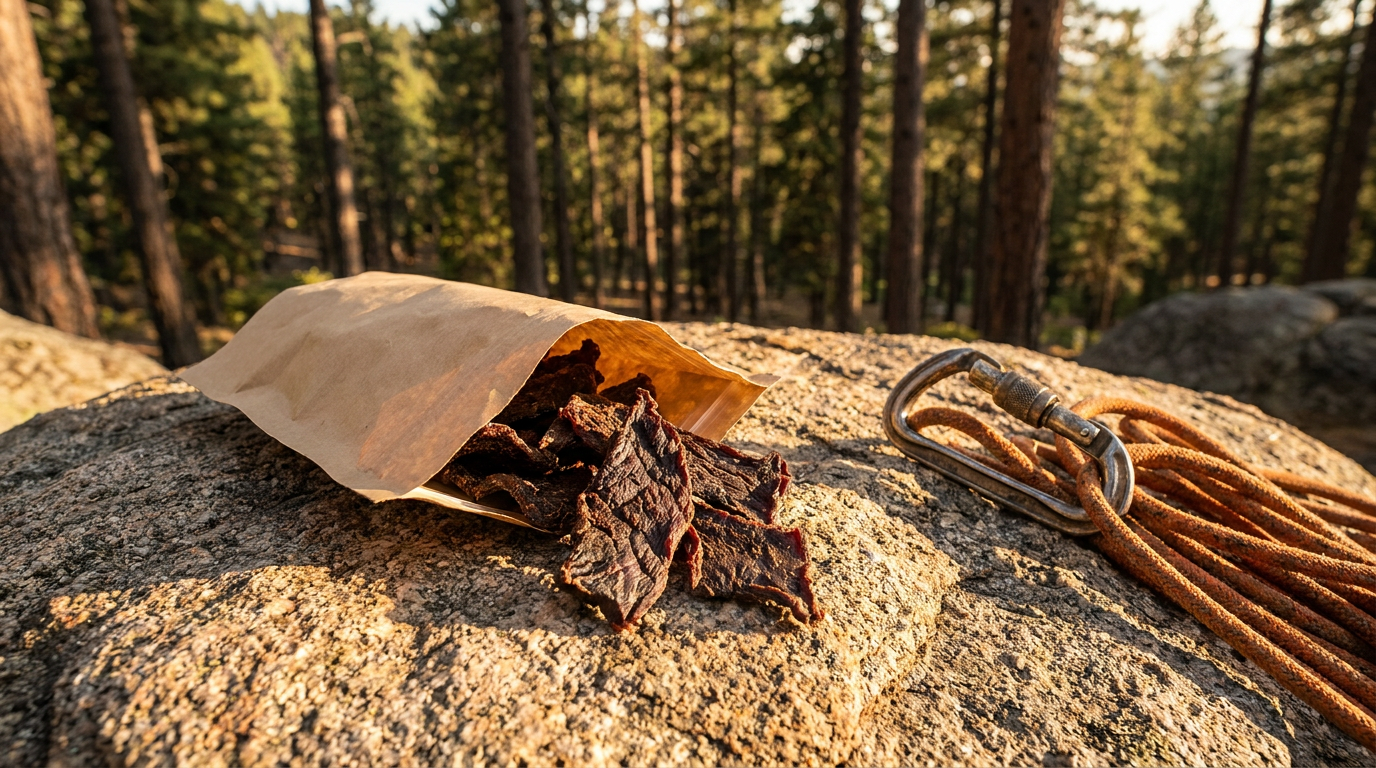
That context point is jerky's actual superpower. It is not the single highest-protein food humans make. It is the highest-protein food that survives a glovebox in July.
Ribeye steak slices · 95g protein per bag
Foods are not healthy or unhealthy in isolation; patterns are. So here is the practical guidance on where jerky earns a spot, how often, and who should mostly pass.
Jerky fits well when:
Jerky fits poorly when:
As for frequency, a defensible pattern for a healthy adult looks like a serving or two a few times a week, inside a diet that is otherwise rich in plants, fiber, and unprocessed foods. That keeps the cumulative processed-meat exposure modest while capturing the protein and convenience benefits. Daily multi-bag consumption is where every concern in this article (sodium, cumulative processed meat intake, crowding out whole foods) starts compounding.
The picture that emerges is neither camp's slogan. Jerky is not a superfood, and it is not a cigarette in snack form. It is concentrated beef with a label problem at one end of the market and a genuinely excellent nutrition profile at the other. Buy from the right end, keep it in the snack lane, and it is one of the most useful protein tools you can keep in a bag.
The healthiest beef jerky is the one with the shortest ingredient list and the best numbers: whole-muscle beef (ideally grass-fed), salt, little or nothing else, 0-1 grams of added sugar, moderate sodium, and high protein per ounce. Products like Caveman Eats represent that end of the market: ribeye steak slices at 95g of protein per 5oz bag, roughly double the protein density of mainstream jerky. Whatever the brand, the label test is the same: fewest ingredients, least sugar, most protein.
For most healthy adults, a serving or two a few times per week is a sensible pattern. That frequency captures jerky's protein and convenience benefits while keeping sodium and cumulative processed-meat intake modest, which is consistent with the American Cancer Society's advice to limit processed meats rather than treat any single food as forbidden. Daily, high-volume jerky consumption is the pattern worth avoiding, especially for anyone watching blood pressure.
Almost always, yes. Ounce for ounce, jerky delivers roughly five to nine times the protein of potato chips at similar or fewer calories, with far less refined carbohydrate and oil. Chips offer essentially no satiety for their calories, while jerky's protein and chew make it genuinely filling. Both are salty, so neither is a free food, but as a swap, jerky for chips is a clear nutritional upgrade.
It depends on the specific products, but a simple-recipe jerky beats the average protein bar on added sugar, ingredient count, and fullness per calorie, since most bars rely on syrups, sugar alcohols, and binders. Bars win on cost per gram of protein and on convenience for people who want something sweet. If your bar habit exists purely to hit protein targets, a high-protein jerky is usually the cleaner way to do the same job.
Because it solves their specific problem: getting complete animal protein between meals without a fridge, a microwave, or a shaker bottle. Jerky is dense in complete protein (including the leucine that drives muscle protein synthesis), very low in carbohydrate and fat in its lean forms, easy to portion, and shelf-stable in a gym bag. It is not superior to whole cooked meat or whey on cost, but it beats both on portability.
Genuinely high-protein options from the junk-food aisle are rare, which is the point of the question. Sweetened jerky is the classic example: real protein wrapped in candy-level sugar. Others include pork rinds (high protein, but fried), certain protein cookies and bars (often 15-plus grams of sugar or sugar alcohols), and cheese-based snack packs. The pattern to notice is that "junk food with protein" is usually a decent protein source plus added sugar or frying; picking the un-junked version of the same food (plain jerky, cheese, unsweetened yogurt) gets you the protein without the baggage.
If the crown goes to protein quality and density combined, animal foods hold it: eggs are the classic reference standard for amino acid quality, whey isolate is the most concentrated practical source (about 90 percent protein by weight), and lean meats like chicken breast and beef sit just behind. Among shelf-stable, ready-to-eat foods, high-protein jerky has a real claim. There is no single king; there is a royal family, and dried lean beef is in it.
This article is for general informational purposes and isn't medical advice.

Best Sellers
Use this text to share information about your collection with your customers.